
Keibann Explained: Meanings, Uses, and Key Facts
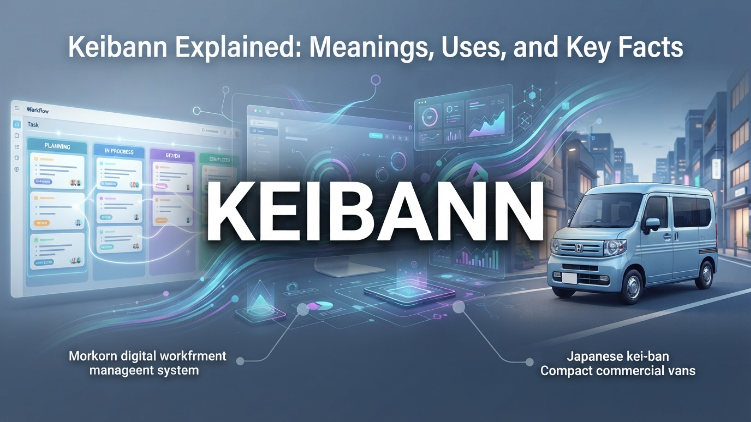
Keibann is a digital term with no single established meaning, and that ambiguity is what makes it especially interesting. Depending on where it appears, the word may refer to a visual task-management approach, a developing technology platform, or the Japanese automotive term kei-ban, used for compact commercial vans.
Understanding the surrounding context is therefore essential. A reference to workflows, tasks, or project boards points toward productivity management, while a discussion of vehicles, delivery fleets, or Japanese automotive regulations usually indicates the kei-ban category. Meanwhile, references to software or online workspaces may describe a developing digital concept rather than a confirmed product.
| Key Point | Overview |
|---|---|
| Term | Keibann |
| Official definition | No single recognized definition |
| Productivity context | Informal variation associated with Kanban |
| Technology context | Possible developing digital workspace or platform |
| Automotive context | Related to Japanese kei-ban light commercial vans |
| Main challenge | Ambiguous meaning across different contexts |
| Verification | Check the source and surrounding information |
What Does Keibann Mean?
The simplest answer is that Keibann does not currently have one universally accepted definition. Its meaning changes according to the context in which it appears.
This is important because a word that looks like a brand name in one discussion may be an informal spelling of an established concept in another. The distinction becomes particularly clear when comparing productivity management with Japanese automotive terminology.
Keibann and Kanban-Style Workflows
In productivity discussions, Keibann can appear as an alternative or informal spelling associated with Kanban, a visual method for organizing work.
A typical Kanban-style board divides tasks into stages such as:
- To Do
- In Progress
- Review
- Completed
Each task is represented visually, often as a card that moves across the board as work progresses. This makes the status of a project easier to understand without requiring lengthy reports.
The method can work for software development, school assignments, content production, personal projects, and small-team operations. Its value comes from making workflow visible and highlighting where tasks are accumulating.
Why Visual Task Management Works
A visual board provides a quick snapshot of workload. Instead of keeping every task in memory, users can see what needs attention and what has already been completed.
The approach can also expose workflow bottlenecks. If numerous cards remain stuck in a single stage, the team may have identified a process problem rather than an individual performance issue.
Common principles include:
- Visualize work so tasks and responsibilities are easy to understand.
- Limit work in progress to prevent too many unfinished tasks from accumulating.
- Monitor workflow by observing how efficiently items move between stages.
- Improve continuously by adjusting the process when recurring problems appear.
This makes Kanban-style systems useful even when a team does not need sophisticated project-management software.
Keibann as a Developing Digital Platform
Another interpretation presents Keibann as a possible digital workspace, software application, or emerging technology brand.
This interpretation requires more caution because a name appearing on blogs or digital discussions does not automatically establish that a fully launched company or product exists. A developing online identity may represent an early-stage project, an informal reference, or a concept that has not yet been publicly finalized.
How to Evaluate an Emerging Digital Name
When encountering an unfamiliar platform associated with Keibann, look beyond the name itself. Useful verification points include:
- An identifiable organization or publisher
- Clear product documentation
- A consistent official web presence
- Transparent contact information
- Published privacy and security information
- Secure HTTPS connections
- Consistent branding across official channels
- Independent information confirming the platform’s existence
These checks help distinguish an established digital service from an unverified website using a similar name.
A particularly important distinction is between a term and a product. A word can circulate widely online without representing a finalized application, company, or technology service.
Keibann in the Japanese Automotive Context
The third major interpretation is connected to kei-ban, written in Japanese as 軽バン. In this setting, the term refers to Japan’s compact light commercial vans.
These vehicles belong to Japan’s broader kei vehicle category, which is defined by strict limits on dimensions and engine capacity. Kei commercial vans are designed around practical transportation needs rather than large exterior dimensions.
What Makes a Kei-Ban Different?
A typical kei-ban is built to maximize useful cargo space within a compact footprint. That combination makes the category particularly suitable for dense urban environments, local deliveries, tradespeople, and small businesses.
Important characteristics include:
- Compact exterior dimensions
- Small-displacement engines
- Practical cargo areas
- Strong emphasis on maneuverability
- Designs suited to narrow streets and urban environments
- Commercial configurations optimized for carrying goods
The category has become an important part of Japan’s small-scale transportation landscape.
Why Compact Commercial Vans Matter
Large delivery vehicles can be difficult to maneuver in crowded urban areas. A small commercial van can provide a different balance between cargo capacity, operating practicality, and physical size.
The boxy shape commonly associated with kei commercial vans also allows manufacturers to make effective use of the available interior volume. Despite their small footprint, some models provide surprisingly adaptable cargo spaces.
Why the Term Can Be Confusing
The biggest issue surrounding Keibann is contextual ambiguity.
A person researching project management could encounter the term and interpret it as a Kanban variation. Someone reading about Japanese vehicles might understand it as a phonetic representation of kei-ban. A technology-focused discussion could instead present it as the name of a developing digital product.
These interpretations are not interchangeable.
For example, a page discussing task columns, workflow stages, and productivity is likely using Keibann in a project-management context. References to Japanese vehicle classifications, cargo capacity, or compact vans point toward the automotive meaning.
The surrounding vocabulary is therefore one of the strongest clues to the intended definition.
How to Verify What Keibann Refers To
When the meaning is unclear, examine the source rather than assuming the word has a fixed definition.
Check the Surrounding Context
Look for related terms. Words such as tasks, workflow, board, backlog, productivity, and project management suggest the Kanban-related interpretation.
Words such as van, cargo, Japan, engine, dimensions, delivery, and commercial vehicle suggest kei-ban.
Terms such as app, workspace, software, account, dashboard, or platform may indicate a technology-related interpretation.
Treat Unverified Platforms Carefully
If a website presents Keibann as a new application or online service, verify its identity before downloading anything or creating an account. An unfamiliar name alone is not evidence that a platform is official or trustworthy.
Basic precautions include checking the site’s security connection, identifying who operates it, reviewing available documentation, and avoiding downloads from sources that cannot be independently verified.
The Future of the Keibann Term
The meaning of Keibann may become clearer if one interpretation develops into an established product or if a consistent definition gains wider acceptance. Until that happens, treating the word as context-dependent is the most accurate approach.
Its three major associations also illustrate how digital terminology can overlap with existing language. A productivity term can resemble an established project-management concept, while the same spelling can point toward Japanese automotive terminology or an emerging technology identity.
For now, Keibann is best understood by examining where and how the term is being used. There is no need to assume that every reference describes the same thing. Identifying the subject matter first—workflow management, software, or Japanese compact commercial vehicles—usually resolves the ambiguity.
Final Takeaway
Keibann is not tied to one universally established definition. It may describe a Kanban-style approach to visual workflow management, appear as the name of a developing digital concept, or relate phonetically to Japan’s kei-ban compact commercial vans.
The safest and most useful way to interpret the term is to examine its surrounding context and verify claims about any supposed platform or product. As the terminology develops, clearer documentation may eventually establish a more specific meaning. Until then, context remains the key to understanding Keibann.