
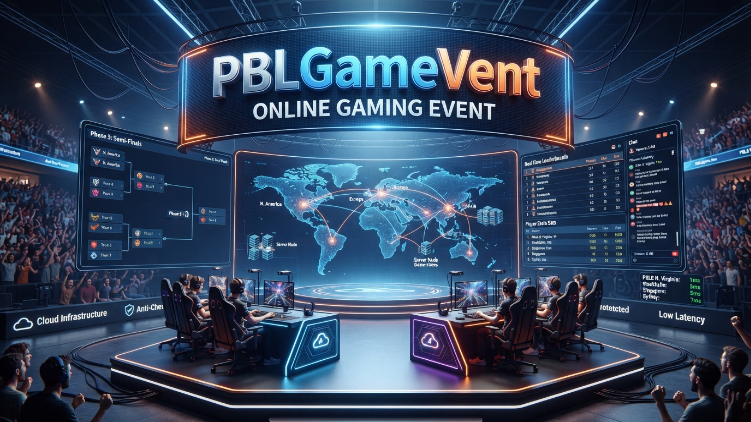
The Online Gaming Event PBLGameVent Explained
Online gaming events have evolved far beyond simple multiplayer matches. Modern tournaments can involve thousands of participants, automated brackets, cloud infrastructure, real-time rankings, live broadcasts, and multiple audience groups operating at once. The online gaming event PBLGameVent describes a conceptual framework for organizing this complex environment as a structured digital system.
PBLGameVent, also described as Hosted Event PBLGameVent, is not presented as one specific physical video game tournament. Instead, it represents a management model for planning, hosting, and executing online gaming events. Its central idea is to connect tournament operations, cloud technology, competitive integrity, streaming, and audience engagement within one coordinated event lifecycle.
| Key Area | PBLGameVent Framework |
|---|---|
| Event type | Structured online gaming event model |
| Core purpose | Planning and managing digital tournaments |
| Tournament formats | Single-elimination, double-elimination, round-robin |
| Infrastructure | Cloud-based gaming services |
| Match performance | Localized, low-latency server deployment |
| Competitive integrity | Server-side anti-cheat measures |
| Audience | Competitive players, casual players, global viewers |
| Broadcast features | Live streams, chat, commentary, interactive elements |
| Event tracking | Automated brackets and real-time leaderboards |
What Is PBLGameVent?
PBLGameVent can be understood as a digital blueprint for managing the many moving parts of an online gaming competition. Rather than focusing solely on gameplay, the framework considers what happens before, during, and after matches.
A modern tournament requires much more than a game server. Organizers must manage participant registration, verify players, create match schedules, determine progression rules, update standings, maintain reliable infrastructure, and provide spectators with a compelling viewing experience.
The framework brings these responsibilities together into a single event-management concept.
From Registration to Final Match
The event lifecycle begins with registration. Participants need a structured process for entering the competition and receiving information about match rules and progression.
Once registration is complete, tournament organizers can establish a bracket appropriate to the event. Common formats include:
- Single-elimination: Players or teams leave the tournament after a loss.
- Double-elimination: Competitors generally receive an additional path through a lower bracket after losing.
- Round-robin: Participants play multiple opponents, with results contributing to overall standings.
Real-time leaderboard updates are another important component. Automated standings reduce the need for manual updates and allow participants and viewers to follow tournament progress as matches are completed.
Cloud Infrastructure Is Central to the Model
Large online gaming events depend heavily on reliable digital infrastructure. When competitors connect from different locations, server performance can directly affect the quality and fairness of gameplay.
A PBLGameVent-style approach therefore emphasizes cloud-based infrastructure capable of supporting large numbers of simultaneous connections.
Why Low Latency Matters
Latency is the delay between a player’s action and the game server registering that action. In fast-paced competitive games, even relatively small delays can affect timing, responsiveness, and match quality.
Localized dedicated servers can help reduce the physical distance between players and the infrastructure hosting their matches. A geographically distributed server strategy can therefore support smoother gameplay for participants connecting from different regions.
The objective is not simply to accommodate more players. Infrastructure must also remain stable under heavy traffic while delivering consistent performance across simultaneous matches.
Server-Side Anti-Cheat Protection
Competitive integrity is another major infrastructure concern. Online tournaments require safeguards against unauthorized software, manipulation, and other forms of unfair play.
Server-side anti-cheat protocols place part of the enforcement responsibility within the event’s technical environment. This can strengthen tournament oversight by making competitive rules part of the infrastructure rather than relying entirely on individual player devices.
For organized competition, fair conditions are essential because tournament progression, rankings, and results depend on trustworthy match outcomes.
PBLGameVent Connects Players and Viewers
One of the framework’s defining characteristics is its dual-focus design. Competitive participants and spectators have very different expectations, yet both groups are part of the same digital event.
Players typically care about:
- Accurate matchmaking
- Clear tournament rules
- Reliable servers
- Bracket progression
- Match results
- Competitive fairness
Viewers, meanwhile, may be more interested in:
- Live broadcasts
- Commentary
- Interactive chats
- Real-time results
- Broadcast presentation
- Memorable competitive moments
A well-designed online event has to serve both audiences without allowing one experience to undermine the other.
Live Streaming as Part of the Event
Streaming is treated as an integrated component rather than an afterthought. Broadcast tools can connect gameplay with commentary, live audience interaction, and visual presentation.
This creates a broader digital experience around the competition. A viewer who is not participating in the tournament can still follow match results, interact with other spectators, and understand the progression of the event.
That distinction is particularly important for esports-style competitions, where the audience can become almost as important to the event ecosystem as the competitors themselves.
Audience Segmentation Shapes the Experience
PBLGameVent also divides its audience into distinct groups instead of assuming every gamer wants the same experience.
Competitive Players
Competitive players generally prioritize precision and structure. Their experience centers on rules, matchmaking, brackets, performance, and progression.
For this group, event software needs to make essential information easy to access. Confusing schedules or unclear progression systems can create unnecessary friction during competition.
Casual Players
Casual participants may respond differently. Community challenges, side activities, and interactive features can provide reasons to participate beyond the primary competitive bracket.
This creates opportunities for an event to support broader community engagement without changing the rules of the main competition.
Global Audiences
Global viewers may never enter a tournament match themselves. Their role is primarily that of spectators following broadcasts, commentary, rankings, and major matchups.
For this audience, presentation and accessibility become important. A tournament can have sophisticated competitive infrastructure while still requiring clear broadcasts and understandable information to remain engaging for spectators.
The Strategic Value of an Integrated Event Model
The biggest strength of the PBLGameVent concept is integration. Registration, tournament logic, infrastructure, anti-cheat systems, leaderboards, streaming, and audience interaction are treated as connected parts of one event.
This approach can help organizers think about an online tournament as a complete digital service rather than simply a collection of matches.
A successful event requires coordination across several layers:
- Participant management establishes who is competing and how they enter.
- Tournament architecture determines how matches are organized and how competitors advance.
- Cloud infrastructure supports connections and gameplay.
- Competitive safeguards help protect match integrity.
- Real-time data systems keep brackets and leaderboards current.
- Broadcast technology turns competition into a spectator experience.
- Audience tools support interaction among viewers and participants.
The framework is therefore best understood as an event-management strategy that connects technical operations with human experience.
Challenges Facing Online Gaming Events
Building a sophisticated digital tournament environment also introduces significant challenges. High participant numbers can place pressure on cloud resources, while geographically dispersed players make latency management more complicated.
Organizers must also balance automation with oversight. Automated brackets and leaderboards improve efficiency, but event administrators still need procedures for unexpected technical problems, disputes, rule violations, and connectivity issues.
Audience segmentation creates another challenge. Competitive players may want a highly focused environment, while casual participants and viewers may prefer more interactive features. Designing an event that accommodates all three groups requires careful planning.
What the Future Could Look Like
The PBLGameVent concept reflects a broader shift toward highly integrated digital event platforms. As online gaming continues to combine competition, broadcasting, community interaction, and cloud technology, tournament organizers increasingly need systems that can handle all these functions together.
Future event models are likely to place even greater emphasis on scalable infrastructure, automated tournament administration, real-time data, anti-cheat technology, and interactive broadcasting.
The underlying principle is straightforward: an online gaming event is no longer defined only by what happens inside a match. It also depends on everything surrounding that match—from registration and server performance to live rankings, broadcast presentation, and community participation.
PBLGameVent provides a useful conceptual way to understand this broader ecosystem. Rather than representing one tournament, it describes how modern online gaming events can be planned as connected digital experiences that serve competitors, casual participants, and worldwide audiences simultaneously.
Understanding the Term in Context
The term PBLGameVent should not automatically be interpreted as the name of a specific tournament or official gaming platform. Its described role is that of a conceptual framework for organizing online gaming events.
Anyone encountering references to a particular registration portal or tournament using the name should independently verify the event’s official identity and source before providing personal information or participating. The term itself does not establish that every website using it represents the same event or organization.
Ultimately, the value of the PBLGameVent concept lies in the systems thinking behind it. By combining tournament management, cloud infrastructure, competitive safeguards, live broadcasting, and audience segmentation, it illustrates the increasingly sophisticated architecture required to deliver a modern online gaming event.