
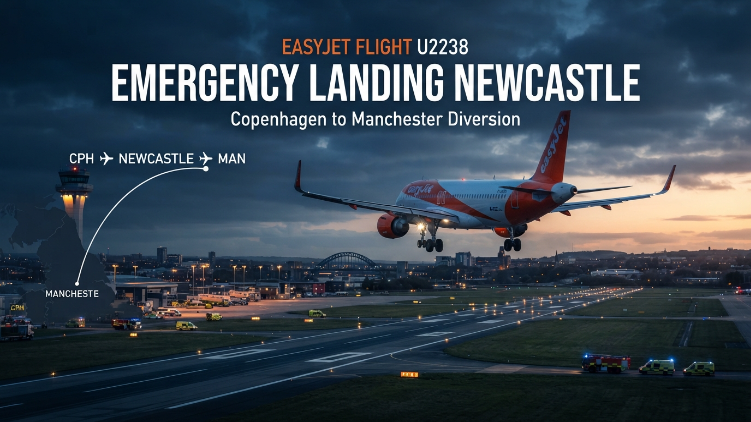
EasyJet Flight U2238 Emergency Landing Newcastle Explained
An ordinary Copenhagen-to-Manchester journey became an unexpected aviation emergency on October 27, 2025, when easyJet flight U22238 diverted to Newcastle Airport after a passenger developed a serious medical problem. The aircraft landed safely, medical responders attended to the passenger, and the flight later continued to Manchester.
The incident is often described online as the easyJet flight U2238 emergency landing Newcastle. However, the more precise flight designations are U22238 and EZY2238. The different formats have caused some confusion, but they refer to the Copenhagen-Manchester service involved in the October 2025 diversion.
| Key Detail | Information |
|---|---|
| Airline | easyJet |
| Flight | U22238 / EZY2238 |
| Route | Copenhagen to Manchester |
| Diversion airport | Newcastle Airport |
| Date | October 27, 2025 |
| Aircraft | Airbus A320-200 |
| Reason | Passenger welfare issue |
| Emergency code | Squawk 7700 |
| Outcome | Continued safely to Manchester |
What Happened to EasyJet Flight U22238?
The flight was operating from Copenhagen Airport in Denmark to Manchester Airport in the United Kingdom. After departing Copenhagen, the Airbus A320 initially followed its planned route across the North Sea.
During the flight, the crew faced an urgent passenger welfare situation. Public reports identified the issue as a medical emergency requiring immediate attention. Rather than continuing toward Manchester, the pilots declared an emergency and redirected the aircraft toward Newcastle Airport.
Flight-tracking information indicates that the aircraft was cruising at approximately 38,000 feet before the emergency diversion. The crew used transponder code 7700, an internationally recognized signal indicating an emergency that requires priority handling from air traffic control.
The decision was based on getting the affected passenger onto the ground and into professional medical care as quickly as reasonably possible.
Why Did the Plane Divert to Newcastle?
Newcastle was a practical diversion airport because of its position along the aircraft’s route and its ability to handle an emergency arrival.
When an in-flight medical situation becomes sufficiently serious, pilots assess several factors before selecting an airport. These can include:
- The passenger’s apparent condition
- Distance to suitable airports
- Runway and airport capabilities
- Weather conditions
- Fuel requirements
- Availability of emergency medical services
- Air traffic conditions
The closest airport is not necessarily selected automatically. The crew and air traffic controllers consider which airport can provide the safest and fastest overall response.
In this case, Newcastle offered an appropriate location for the aircraft to land and for medical personnel to meet the passenger. The diversion therefore represented a safety decision rather than evidence that the aircraft itself was failing.
What Does a “Passenger Welfare Issue” Mean?
EasyJet described the situation as a “passenger welfare issue.” That wording is deliberately broad and does not disclose private medical information about the individual involved. Contemporary reporting identified the event as a medical emergency onboard.
A passenger can become seriously unwell for many different reasons during a flight. Cabin crew receive training to respond to medical situations, but an aircraft has obvious limitations compared with a hospital or emergency department.
If the condition appears to require immediate treatment that cannot adequately be provided in the cabin, landing becomes the safest option.
Importantly, an emergency declaration does not automatically mean the aircraft has suffered a mechanical failure. In the U22238 incident, available reporting attributes the diversion to the passenger’s welfare rather than an aircraft malfunction.
How the Emergency Landing Was Handled
Flight-tracking records show that U22238 landed at Newcastle Airport at approximately 22:52 GMT on October 27. Medical responders were ready to assist when the aircraft arrived.
Once the aircraft reached the ground, the medical situation could be transferred from the confined environment of the cabin to professional emergency services.
The landing itself was completed safely. The aircraft then remained at Newcastle while the passenger received assistance and the airline dealt with the operational requirements associated with the diversion.
The incident also affected other aircraft operating in the area. Reporting at the time indicated that at least one other flight was placed into a holding pattern while the emergency aircraft landed. This is a normal consequence of giving priority to an aircraft that has declared an emergency.
Did the Flight Continue to Manchester?
Yes. The diversion did not become the final destination for the remaining passengers.
After the aircraft had dealt with the medical situation and completed the necessary ground procedures, it departed Newcastle and continued toward Manchester. Flight records indicate that the aircraft later reached Manchester shortly after midnight.
This outcome illustrates an important distinction between an emergency landing and an aircraft being permanently grounded. An emergency diversion is often a temporary change to the flight plan. Once the immediate problem has been addressed and the aircraft is cleared to continue, the original journey can resume.
What Does Squawk 7700 Mean?
The appearance of 7700 on flight-tracking platforms can make an incident appear particularly alarming. It is important to understand what the code actually means.
Squawk 7700 is a standard transponder code used by aircraft experiencing an emergency. It alerts air traffic controllers that the flight needs priority assistance.
The code itself does not identify the specific nature of the emergency. It could be associated with a medical situation, technical problem, severe operational issue, or another urgent circumstance.
For U22238, the emergency code was followed by a diversion to Newcastle, while reports attributed the underlying reason to a passenger welfare issue.
Clearing Up the U2238 and U22238 Confusion
One of the most noticeable details surrounding this incident is the variation in the flight number.
The airline flight is commonly identified as U22238, while aviation systems can display EZY2238. Some online references shorten the number further to U2238, which is why the phrase “easyJet flight U2238 emergency landing Newcastle” appears in discussions of the event.
For accurate identification, U22238 and EZY2238 are the useful references for the Copenhagen-Manchester flight involved in the October 27, 2025 diversion. Flight-tracking records confirm U22238 as the relevant service.
This distinction matters because similar-looking flight numbers can otherwise lead to unrelated services being incorrectly connected to the incident.
Was There an Aircraft Technical Failure?
Available reporting does not indicate that the Newcastle diversion was caused by an engine problem, fire, structural failure, or other major aircraft malfunction.
The consistent explanation is that the crew diverted because of a passenger welfare issue. The Airbus A320 subsequently continued to Manchester, supporting the account that the diversion was primarily related to the medical situation rather than an aircraft problem.
It is nevertheless important not to speculate about the passenger’s medical condition. Public information does not establish private medical details, and the airline’s description appropriately remains general.
Why Medical Diversions Are an Important Safety Measure
The easyJet flight U2238 emergency landing Newcastle incident demonstrates how commercial aviation responds when circumstances change unexpectedly.
Pilots plan flights around a specific route, altitude, fuel requirement, weather forecast, and destination. A serious medical situation can quickly change those priorities.
A diversion can involve:
- Coordination between the cockpit and cabin crew
- Communication with air traffic control
- Selection of an appropriate airport
- Preparation of emergency services
- Priority routing and landing
- Medical handover after touchdown
- Aircraft checks and operational procedures
- Reassessment of whether the flight can continue
The process may appear dramatic to passengers and people watching flight-tracking data, but these procedures are designed to make emergency decisions structured and predictable.
The Final Outcome of the Newcastle Diversion
The most important fact is that the aircraft landed safely in Newcastle and the affected passenger was met by medical personnel. The remaining journey was subsequently completed, with U22238 continuing to Manchester after the diversion.
The incident was therefore not a crash or forced landing caused by an aircraft failure. It was an emergency medical diversion in which the flight crew prioritized a passenger’s immediate welfare over continuing directly to the scheduled destination.
For passengers, the event is a reminder that flight plans can change rapidly when an urgent situation develops. For aviation observers, it also provides a clear example of how an emergency declaration, air traffic control priority, airport response, and medical intervention work together to protect people in the air.
Final Takeaway
The easyJet flight U2238 emergency landing Newcastle refers to the October 27, 2025 diversion of easyJet U22238, also identified as EZY2238, while traveling from Copenhagen to Manchester.
The aircraft diverted because a passenger required urgent medical attention. The crew declared an emergency, redirected the Airbus A320 to Newcastle, landed safely, and enabled medical responders to assist the passenger. The aircraft later resumed its journey and arrived in Manchester.
The available evidence points to a passenger welfare emergency rather than a major aircraft malfunction. Most importantly, the diversion demonstrated the central principle behind emergency aviation procedures: when an urgent situation develops, the flight plan can change immediately to protect the people onboard.