Rifle Bookshelf Jigsaw Puzzle: Complete Guide and Review
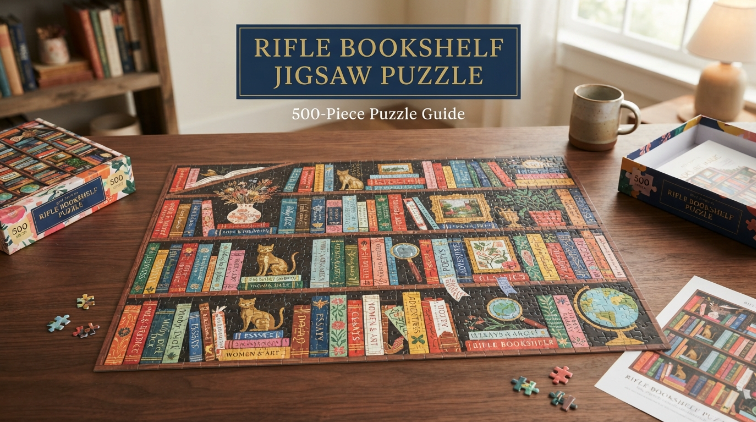
A bookshelf can tell a story without a single page being opened, and the rifle bookshelf jigsaw puzzle turns that idea into a detailed tabletop challenge. The puzzle, officially titled Bookshelf by Rifle Paper Co., combines illustrated book spines, decorative objects, and a carefully arranged shelf scene into a 500-piece composition. Its finished dimensions are 15 by 21 inches, while the pieces are approximately 0.75 inches across.
The appeal comes from the contrast between recognizable visual patterns and deceptively difficult sections. Books provide strong shapes and colors, while dark shelf areas and repeated details require more careful sorting and placement.
| Key Fact | Details |
|---|---|
| Puzzle name | Bookshelf |
| Brand | Rifle Paper Co. |
| Piece count | 500 pieces |
| Finished size | 15 × 21 inches |
| Piece size | Approximately 0.75 inches |
| Artwork | Illustrated bookshelf scene |
| Packaging | Book-shaped box |
| Visual style | Literary, decorative, colorful |
| Construction | Printed greyboard |
| Special detail | Metallic gold foil accents |
What Is the Rifle Bookshelf Jigsaw Puzzle?
The rifle bookshelf jigsaw puzzle is a 500-piece illustrated puzzle centered on a front-facing bookshelf. Rather than depicting a single landscape or photograph, the artwork presents a collection of books and decorative objects arranged across shelves.
Rifle Paper Co. describes the design as a lineup of classic titles and decorative elements. The completed image measures 15 inches wide by 21 inches long, creating a relatively large rectangular playing area while keeping the piece count approachable for casual and experienced puzzlers alike.
A Bookshelf as the Main Subject
The choice of a bookshelf creates several natural visual zones. Book spines provide vertical edges, lettering, blocks of color, and repeated rectangular shapes. Decorative objects break up those patterns and create additional reference points.
This makes the image visually interesting even before the puzzle is assembled.
Design and Visual Details
One of the strongest characteristics of this bookshelf puzzle is its illustrated rather than photographic appearance. The artwork uses decorative details that reward close inspection.
The puzzle includes classic-looking book spines alongside objects that contribute to the overall literary atmosphere. The packaging itself reinforces that theme: the puzzle comes in a paper-wrapped box designed to resemble a book, complete with a magnetic closure and gold foil accents.
Color and Pattern Recognition
Color is particularly useful when solving this type of puzzle. Individual book sections can often be grouped according to dominant shades, borders, or spine designs.
However, not every section is equally easy. Dark areas can contain pieces with similar colors, making shape and cut patterns more important than color alone.
How Difficult Is the 500-Piece Puzzle?
A 500-piece jigsaw is generally more approachable than a 1,000- or 2,000-piece puzzle, but the number of pieces does not tell the entire story.
The rifle bookshelf jigsaw puzzle has several characteristics that can make certain stages surprisingly challenging.
Why Some Sections Take Longer
The bookshelf contains repeated horizontal and vertical structures. Once the obvious book sections are assembled, remaining pieces may belong to shelves, dark backgrounds, or small decorative areas.
Experienced puzzlers commonly use several methods to overcome this:
- Sort pieces by dominant color.
- Separate edge pieces before beginning the interior.
- Group pieces according to image details.
- Pay attention to connector shapes.
- Build recognizable book spines first.
- Leave highly repetitive sections until later.
One published customer review described the book portions as comparatively easy while finding the black and shelf sections more challenging.
A Practical Strategy for Solving It
The best approach depends on individual puzzle habits, but a structured method can reduce frustration.
Start With the Frame
The edge pieces create the outer boundary and provide a useful reference for everything that follows. Once the border is complete, the remaining workspace becomes easier to organize.
Next, identify distinctive visual elements. Unusual book colors, lettering, ornaments, or objects generally provide better starting points than large areas of similar texture.
Build by Visual Zones
Instead of searching through every loose piece repeatedly, divide the puzzle into sections.
For example, you might create groups for:
- Book spines
- Dark shelf areas
- Decorative objects
- Background sections
- Edge and corner pieces
This approach turns a large collection of loose pieces into smaller, manageable sets.
Material and Construction
The puzzle uses greyboard with a matte coating and is printed in full color. Rifle Paper Co. lists the individual piece size at approximately 0.75 inches.
Material matters because puzzle pieces need enough rigidity to be handled repeatedly without becoming excessively flexible. A matte surface can also reduce glare under strong indoor lighting, which is helpful when examining small printed details.
The book-style packaging adds another distinctive element. Instead of a conventional square or rectangular puzzle box, the container is designed to resemble a book on a shelf, matching the theme of the artwork.
Why Bookshelf-Themed Puzzles Are Appealing
Bookshelf puzzles occupy an interesting space within the wider jigsaw hobby. They combine the satisfaction of assembling a puzzle with imagery associated with reading, collecting, interior decoration, and personal libraries.
A bookshelf also provides a naturally structured composition. Rows, columns, book spines, and repeated shapes give the eye many reference points.
That makes the finished image feel more like a miniature illustrated scene than an abstract arrangement of pieces.
What Makes the Finished Image Interesting?
The completed puzzle works because its visual details remain engaging after the final piece is placed. Book titles, decorative objects, patterns, and shelf arrangements create small areas that can be examined individually.
The composition also benefits from visual repetition. Similar books may initially make solving harder, but once assembled, those repeated forms help create the appearance of a coherent bookshelf.
The result is particularly suited to people who enjoy puzzles based on interiors, books, libraries, and illustrated collections.
Common Challenges to Expect
No bookshelf puzzle is difficult in exactly the same way as another. Here, the main challenge is likely to come from areas where pieces share similar colors or textures.
The most useful habits are patience and controlled sorting. Trying random pieces across the entire puzzle usually wastes time. Working within a defined section makes it easier to recognize both image details and piece shapes.
Another practical consideration is the reference image. One customer review noted that the solving picture was relatively small and suggested that a larger reference image would be helpful.
Final Thoughts on the Rifle Bookshelf Jigsaw Puzzle
The rifle bookshelf jigsaw puzzle combines a manageable 500-piece format with highly detailed illustrated artwork. Its 15-by-21-inch finished size provides enough room for the bookshelf scene to feel substantial without reaching the scale of larger jigsaw challenges.
Its greatest strength is the artwork: books, shelves, decorative objects, and carefully arranged details create both a recognizable subject and a genuine solving challenge. The book-shaped packaging extends the concept beyond the puzzle itself, making the entire presentation consistent with its literary theme.
For puzzle enthusiasts who enjoy illustrated interiors and book-related imagery, it offers a distinctive alternative to landscapes, animals, and traditional photographic scenes.
Frequently Asked Questions
How many pieces are in the Rifle Bookshelf jigsaw puzzle?
The puzzle contains 500 pieces. Its completed dimensions are 15 inches by 21 inches.
What size are the puzzle pieces?
Rifle Paper Co. lists the pieces at approximately 0.75 inches in size.
What does the puzzle depict?
It depicts an illustrated bookshelf filled with classic-looking book titles and decorative objects.
Is the puzzle difficult?
The 500-piece format is relatively approachable, but sections with dark colors, shelves, and repeated patterns can require more careful sorting and piece-shape matching.
What is distinctive about the packaging?
The puzzle is packaged in a book-shaped, paper-wrapped box featuring a magnetic closure and gold foil accents.