Utah Jazz vs Memphis Grizzlies Match Player Stats: April 2026 Breakdown
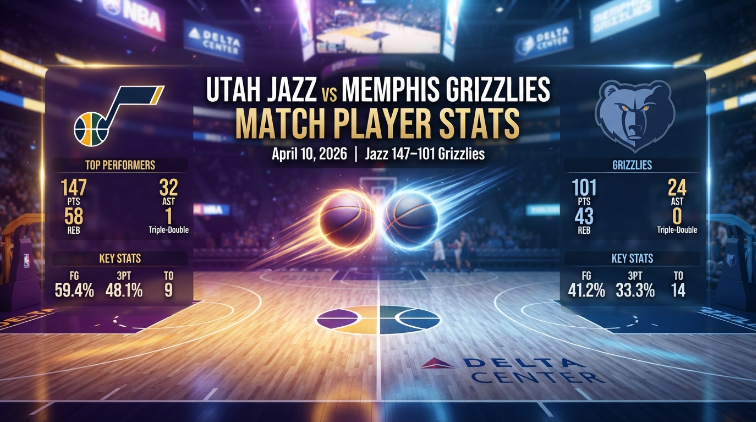
The Utah Jazz vs Memphis Grizzlies match player stats from April 10, 2026, tell the story of an unusually dominant offensive performance. Utah overwhelmed Memphis 147-101 at the Delta Center, turning the final regular-season meeting between the teams into a one-sided contest. The Jazz combined efficient scoring with strong rebounding and playmaking, while several players filled multiple statistical categories.
| Key Fact | Utah Jazz | Memphis Grizzlies |
|---|---|---|
| Final Score | 147 | 101 |
| Venue | Delta Center | Away |
| Leading Scorer | Blake Hinson, 30 | Dariq Whitehead, 21 |
| Leading Rebounder | Oscar Tshiebwe, 22 | Jahmai Mashack, 15 |
| Leading Assists | Bez Mbeng, 11 | Jahmai Mashack, 14 |
| Notable Performance | Two triple-doubles | One triple-double |
Utah Jazz Player Stats
Utah’s biggest advantage came from the number of players contributing across several categories. The Jazz did not depend on one scorer alone; instead, their attack featured multiple high-output performances.
Blake Hinson Sets the Scoring Pace
Blake Hinson led Utah with a career-high 30 points in 35 minutes. He shot 12-of-19 from the field, giving him one of the most efficient high-volume scoring performances of the game.
His scoring provided an early foundation for Utah’s offensive surge. Rather than relying entirely on outside shooting, the Jazz consistently generated scoring opportunities and maintained pressure throughout the game.
Bez Mbeng and John Konchar Fill Every Category
Bez Mbeng produced one of the most complete performances on the Utah roster. He finished with 27 points, 11 rebounds and 11 assists, completing a triple-double while shooting 12-of-19.
John Konchar also recorded a triple-double, posting 11 points, 11 rebounds and 10 assists. He added five steals and two blocks, making his contribution particularly important on the defensive end.
Having two players reach triple-doubles in the same game highlighted Utah’s overall balance. The Jazz were not simply scoring efficiently; they were also moving the ball, controlling possessions and creating opportunities through rebounding.
Other Important Jazz Contributions
Kennedy Chandler added 26 points and 10 assists, while Ace Bailey finished with 23 points and 10 rebounds. Oscar Tshiebwe was particularly effective on the glass, collecting 22 rebounds along with 16 points and two blocks.
Cody Williams contributed 14 points, three rebounds and five assists, giving Utah another reliable ball-handling and scoring option.
The combined production meant Memphis had to defend several threats simultaneously rather than concentrating on a single player.
Memphis Grizzlies Player Stats
The Grizzlies struggled to match Utah’s offensive efficiency, but several individual performances still stood out.
Dariq Whitehead Leads Memphis Scoring
Dariq Whitehead was Memphis’ top scorer with 21 points in 24 minutes, shooting 8-of-18 from the field. His scoring was one of the brighter individual results for the Grizzlies in a difficult team performance.
Toby Okani followed with 20 points, although he needed 22 field-goal attempts to reach that total. Rayan Rupert added 16 points and 12 rebounds while also recording three steals and a block.
Jahmai Mashack Delivers a Triple-Double
Jahmai Mashack produced Memphis’ most versatile statistical performance. He recorded 13 points, 15 rebounds and 14 assists, completing a triple-double while shooting 6-of-13.
His 14 assists demonstrated Memphis’ reliance on him as a playmaker, while his 15 rebounds showed his activity around the basket. Despite the individual numbers, the Grizzlies could not convert that production into enough team scoring to keep pace with Utah.
Lucas Williamson also played 48 minutes and finished with 13 points, 13 rebounds and three assists, adding four steals.
Why the Utah Jazz Won by 46 Points
The 46-point margin was the clearest indication of how thoroughly Utah controlled the game.
Offensive Efficiency
Utah had several players shooting efficiently from the field. Hinson, Mbeng, Bailey and Tshiebwe all converted at strong rates based on the supplied box score.
The Jazz also benefited from multiple playmakers. Mbeng and Chandler combined for 21 assists, while Konchar added 10. That distribution allowed Utah to create scoring opportunities without forcing every possession through one primary option.
Rebounding and Second-Chance Opportunities
Oscar Tshiebwe’s 22 rebounds were especially significant. Utah also received double-digit rebounding performances from Mbeng, Bailey and Konchar.
Controlling the boards can create extra possessions and prevent an opponent from establishing a consistent transition game. Utah’s collective rebounding effort helped maintain its advantage throughout the contest.
Defensive Activity
Konchar’s five steals and two blocks stood out, while several other Jazz players contributed defensive plays. Utah’s defensive activity made it difficult for Memphis to sustain efficient possessions.
The Grizzlies, meanwhile, had several players with high minutes totals, but the team’s overall production remained well behind Utah’s.
The Most Significant Statistical Performances
Several individual lines deserve special attention when reviewing the matchup:
- Blake Hinson: 30 points, 2 rebounds, 2 assists
- Bez Mbeng: 27 points, 11 rebounds, 11 assists
- Kennedy Chandler: 26 points, 5 rebounds, 10 assists
- Ace Bailey: 23 points, 10 rebounds, 2 assists
- Oscar Tshiebwe: 16 points, 22 rebounds, 3 assists
- John Konchar: 11 points, 11 rebounds, 10 assists, 5 steals, 2 blocks
- Dariq Whitehead: 21 points, 3 rebounds
- Toby Okani: 20 points, 2 rebounds, 2 assists
- Rayan Rupert: 16 points, 12 rebounds, 4 assists
- Jahmai Mashack: 13 points, 15 rebounds, 14 assists
These numbers show why the game became so lopsided. Utah had scoring depth, multiple rebounders and several players capable of creating offense for teammates.
What the Box Score Says About Both Teams
The statistical contrast is more revealing than the final score alone. Utah had multiple players reaching major milestones, including two triple-doubles, while Tshiebwe dominated the rebounding category.
Memphis had its own standout triple-double from Mashack, but the surrounding production was not enough to close the gap. The Grizzlies’ leading scorers also faced a significant efficiency challenge compared with Utah’s primary contributors.
The result was a game where individual Memphis performances could not overcome Utah’s collective statistical advantage.
Final Takeaway
The Utah Jazz vs Memphis Grizzlies match player stats from April 10, 2026, show one of Utah’s most statistically dominant regular-season performances of the matchup. Hinson’s 30-point outburst led the scoring, while Mbeng and Konchar produced rare triple-doubles. Tshiebwe controlled the boards with 22 rebounds, and Chandler and Bailey supplied additional high-level production.
Memphis had notable efforts from Whitehead, Rupert and Mashack, with Mashack recording a triple-double of his own. However, Utah’s depth, shooting efficiency, rebounding and playmaking created an overwhelming statistical advantage.
The 147-101 result therefore reflects more than a hot scoring night. It was a complete team performance in which Utah controlled multiple areas of the box score from start to finish.