Our Team HearthStats: History, AI & Hearthstone Analytics
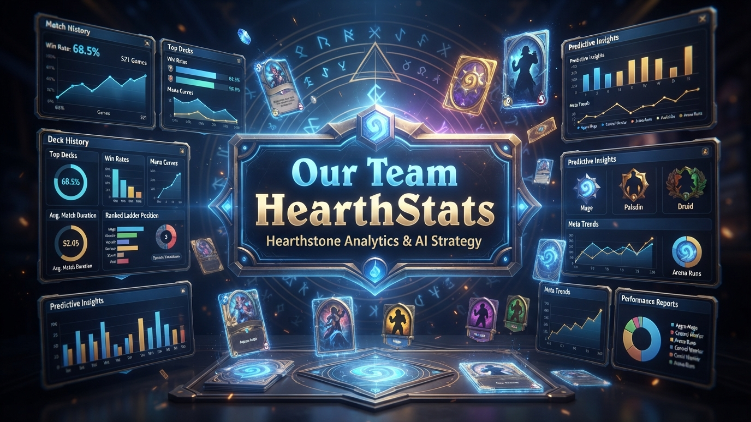
Our Team HearthStats represents a name connected to two different eras of Hearthstone data analysis: the original HearthStats platform that helped players track matches and deck performance, and a newer AI-based assistant focused on interpreting statistics and strategy. Understanding that evolution shows how game analytics has moved from simple match records toward adaptive, data-driven guidance.
| Key Fact | Details |
|---|---|
| Platform | HearthStats |
| Original focus | Hearthstone match and deck analytics |
| Major acquisition | GAMURS, 2016 |
| Core data | Win rates, match history, deck performance |
| Modern association | AI strategy and stat analysis |
| Current AI platform | Shapes AI |
| Primary audience | Hearthstone players |
| Main functions | Deck analysis, statistics, strategy guidance |
The Origins of HearthStats
HearthStats emerged during the early development of Hearthstone as a companion platform for players who wanted more information about their games. Rather than relying only on the game’s built-in results, players could use tracking tools to record matches and study performance over time.
The concept was straightforward but valuable. A player could look beyond a single victory or defeat and identify patterns involving decks, classes, matchups, and win rates.
Why Match Tracking Mattered
Competitive card games generate large amounts of information during ordinary play. A player might remember losing several games against a particular class without knowing whether that matchup was genuinely weak or simply affected by a short losing streak.
Tracking systems help separate perception from measurable results.
Useful statistics can include:
- Overall win rate
- Performance by deck
- Class matchup results
- Individual match histories
- Trends across multiple games
- Deck-specific performance
This approach helped establish game statistics as an important part of serious Hearthstone analysis.
The HearthStats Acquisition by GAMURS
A major milestone came in 2016, when GAMURS acquired HearthStats. Contemporary reporting described HearthStats as an analytical platform designed to help Hearthstone players improve their performance, while the acquisition was expected to strengthen GAMURS’ Hearthstone coverage with additional statistical information.
The acquisition is important because it marked a transition in the platform’s history. HearthStats was no longer simply an independent companion tool; it became connected to a broader gaming-media organization.
Over time, however, the original tracking ecosystem declined as other tools became more prominent within the Hearthstone community. This illustrates a common challenge for gaming analytics platforms: tracking technology must continuously adapt when the underlying game changes.
What Happened to the Original Platform?
The original HearthStats concept was built around automated data collection and match analysis. That model depended heavily on reliable integrations and continued technical maintenance.
As Hearthstone evolved through expansions, balance changes, client updates, and changes in the surrounding tracking ecosystem, maintaining compatibility became increasingly important.
The result was a gradual shift away from HearthStats as a central tracking destination.
This history also explains why the phrase our team hearthstats can be confusing today. It does not necessarily refer to the original group of developers operating the classic tracker. The name has since appeared in newer digital contexts, including AI-assisted Hearthstone analysis.
The Modern Meaning of Our Team HearthStats
The most notable modern interpretation is an AI-based Hearthstone strategy and statistics assistant on Shapes AI.
According to its current description, the tool focuses on deck analysis, match tracking, win-rate interpretation, and strategy recommendations. It is designed to process player information and provide practical guidance rather than simply display raw statistics.
From Raw Statistics to Recommendations
This represents an important change in how gaming analytics can work.
A traditional tracker might tell a player:
Deck A has a 55% win rate.
An analytical assistant can go further by considering questions such as:
- Which matchups are producing the strongest results?
- Where is the deck underperforming?
- Which cards or combinations appear important?
- How does the strategy fit the current competitive environment?
- What changes could improve consistency?
The distinction is between measurement and interpretation.
Measurement provides the numbers. Interpretation attempts to explain what those numbers mean.
How the AI Assistant Approaches Deck Analysis
The modern our team hearthstats assistant is described as using deck statistics and meta information to provide strategy recommendations. Its workflow involves examining a deck or match situation, processing relevant statistics, generating recommendations, and refining those recommendations through follow-up analysis.
Deck Evaluation
Deck analysis can examine factors such as card combinations, strategic consistency, matchup performance, and overall win-rate trends.
A useful analysis should not treat a single statistic as definitive. A 60% win rate over ten games, for example, provides much less evidence than the same percentage across hundreds of games.
Match Performance
Match history provides another layer of information.
Instead of considering every game independently, an analytical system can look for recurring patterns. These might include difficulties against particular archetypes, inconsistent early-game performance, or strong results when a certain strategic approach is used.
Meta Awareness
Hearthstone is a constantly changing competitive environment. Balance adjustments and new cards can change the relative strength of decks and strategies.
Research into Hearthstone strategy has also demonstrated why this environment is particularly suitable for computational analysis: card interactions, hidden information, randomness, and changing strategic conditions create a complex decision-making problem.
The Importance of Data Quality
Even sophisticated analysis is only as useful as the information behind it.
A tracking system may produce misleading conclusions when the sample is too small, incomplete, or biased toward a particular type of player.
For example, three consecutive losses do not necessarily prove that a deck is weak. Likewise, a short winning streak does not automatically establish that a strategy is optimal.
Good analysis therefore considers:
- Sample size
- Matchup distribution
- Player skill
- Deck construction
- Game format
- Recent balance changes
- Statistical variance
This is one reason win rate should be treated as evidence rather than absolute truth.
HearthStats as a Data-Driven Gaming Concept
The broader legacy of HearthStats extends beyond one website or one particular tool. It reflects a larger movement in gaming toward measurable performance.
Players increasingly have access to:
- Match databases
- Deck trackers
- Performance dashboards
- Win-rate statistics
- Meta reports
- Automated recommendations
- AI-assisted strategy analysis
This ecosystem changes how players learn. Instead of depending entirely on memory, they can compare decisions against accumulated match data.
HearthStats.net and the Changing Brand Context
The HearthStats name also appears on a current website using the HearthStats identity for gaming and general content. Its homepage describes HearthStats.net as a source for Hearthstone-related news and updates and uses the phrase our team hearthstats in its editorial presentation.
That means the name now exists across several related but distinct contexts:
- The original Hearthstone analytics platform.
- The historical HearthStats brand associated with GAMURS.
- A modern AI assistant on Shapes AI.
- A contemporary HearthStats-branded content website.
These should not automatically be treated as the same operational product.
What the Future Could Look Like
The evolution from automated tracking toward AI-assisted analysis suggests where gaming statistics may continue to develop.
Future systems could increasingly combine match history, deck composition, opponent tendencies, game-state information, and broader meta data to produce more contextual recommendations.
The biggest opportunity is not simply collecting more numbers. It is making those numbers understandable and useful.
An effective assistant should help answer the question behind the statistic: What does this information mean for the next game?
That is the central idea connecting the original HearthStats platform with the newer our team hearthstats concept. The technology has changed, but the underlying goal remains familiar: turn Hearthstone gameplay data into practical insight.
Final Thoughts on Our Team HearthStats
Our Team HearthStats reflects the evolution of Hearthstone analytics from basic match tracking to intelligent statistical interpretation. The original HearthStats platform helped establish the value of recording win rates and deck performance, while its later acquisition by GAMURS marked a significant chapter in its history.
Today, the name is also associated with an AI assistant designed to analyze decks, match statistics, and competitive strategy.
The broader lesson is clear: game analytics becomes most valuable when raw statistics are transformed into context. Whether the information comes from a traditional tracker or an AI-assisted system, the goal is to understand patterns, recognize weaknesses, and make better-informed strategic decisions.
FAQs About Our Team HearthStats
What is Our Team HearthStats?
It is a name associated with Hearthstone statistics, deck analysis, match tracking, and a modern AI strategy assistant available through Shapes AI.
What was the original HearthStats platform?
The original HearthStats platform was a Hearthstone companion and analytics service focused on tracking matches, win rates, and deck performance.
Who acquired HearthStats?
GAMURS acquired HearthStats in 2016.
What does the modern AI assistant analyze?
It focuses on deck statistics, match performance, win-rate information, strategy recommendations, and meta-related guidance.
Why are Hearthstone statistics useful?
Statistics can reveal performance patterns that are difficult to identify from memory alone, helping players evaluate decks, matchups, and strategic decisions over larger samples.